Destination guide
Taormina and Mazzarò
Before it was a postcard, Taormina was a theatre. Literally: a 3rd-century-BC Greek amphitheatre carved into the rock, with Mount Etna smoking in the background — arguably the most photographed natural backdrop on earth. Mazzarò, the bay below, is where that same scene runs down to the sea.
From Naxos to Taormina: the Greek founding
The area's story starts further down the coast, at Naxos, Sicily's first Greek colony, founded around 734 BC by Chalcidians from Euboea. Naxos was destroyed in 403 BC by Dionysius I of Syracuse.
Taormina was founded shortly after by the Carthaginian Himilco after 398 BC, settled by Sicels who had survived Naxos's destruction. In 392 BC the city was recaptured and Hellenised by Dionysius of Syracuse himself, and in 358 BC it was enlarged under Andromachus — father of the historian Timaeus — who gathered the remaining Naxos survivors there.
The Ancient Theatre, between Hellenism and Rome
Taormina's Ancient Theatre was built in the 3rd century BC in the Hellenistic period, likely under Hiero II of Syracuse: carving it out of the rock meant removing more than 100,000 cubic metres of stone by hand. Under Roman rule, probably around the time of Hadrian or Trajan, the theatre was rebuilt.
It's the second-largest ancient theatre in Sicily after the one in Syracuse, and remains one of the island's most visited monuments — still hosting events today, and still framing the view of Etna over the stage that made it famous.
From the Grand Tour to the Belle Époque
Goethe praised Taormina in his "Italian Journey", helping turn it into a fixed stop on the 19th-century Grand Tour of European aristocracy. The Grand Hotel Timeo, which opened around that time, brought the Belle Époque to Taormina: Kaiser Wilhelm II of Germany stayed there in 1896 and returned in 1904 and 1906, renting the entire hotel for his family; Edward VII, King of England, was a guest in 1906, 1907, and 1908.
Between March 1920 and February 1922, Taormina was home to the writer D.H. Lawrence and his wife Frieda, guests of Don Cicco Cacopardo at the house Fontana Vecchia. Lawrence wrote that he loved Taormina more than any other place, for the sunrise over the open sea to the east. Oscar Wilde, and later Elizabeth Taylor and Greta Garbo, were among others who chose this stretch of coast as a discreet retreat.
Mazzarò and Isola Bella: the bay below the town
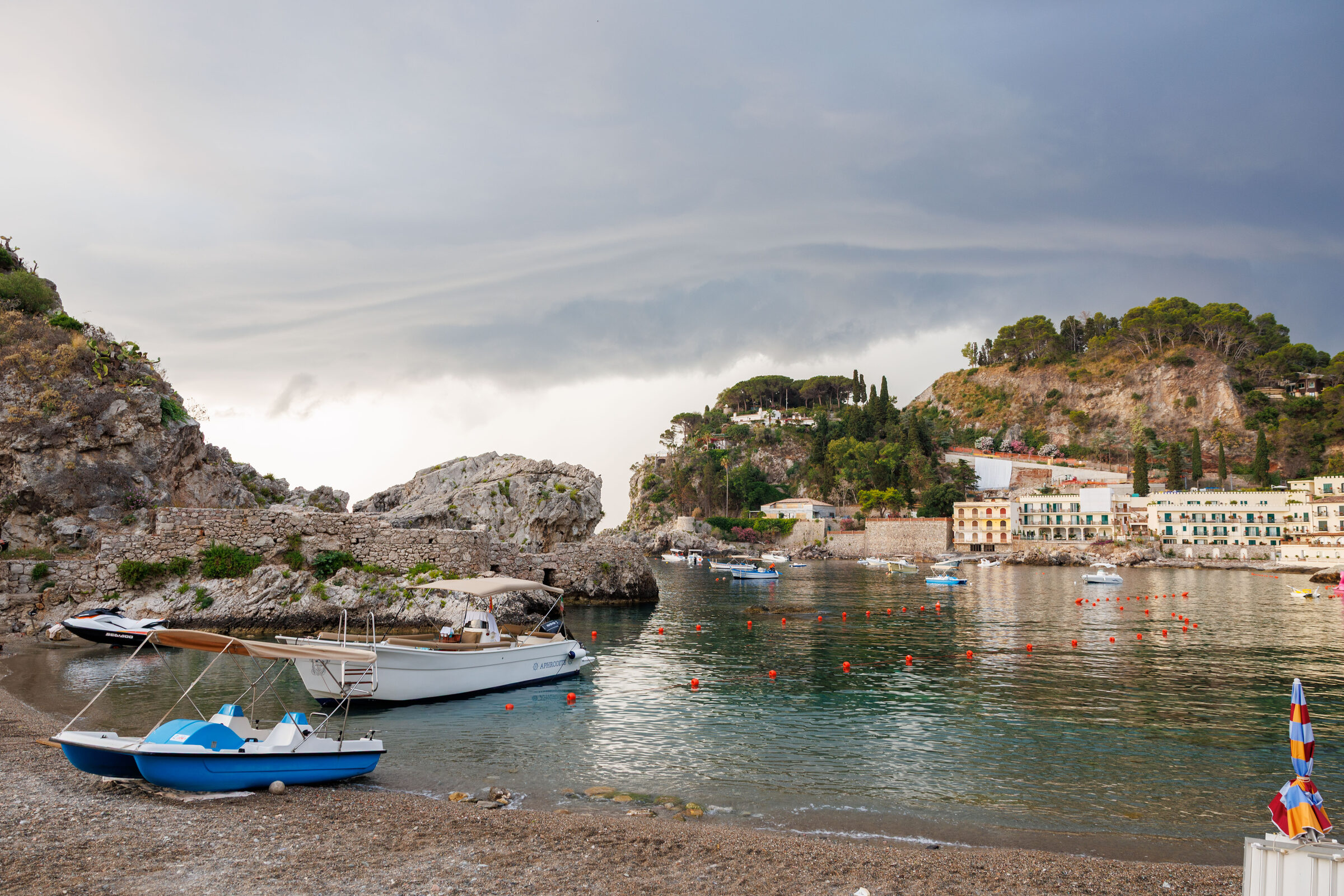
Mazzarò is the seaside district at the foot of Taormina, reached from the historic centre by the Taormina–Mazzarò cable car, which carries roughly 850,000 people a year. Right off the bay sits Isola Bella, a small island connected to the beach by a strip of sand.
In 1806, Ferdinand I of Bourbon donated the islet to the municipality of Taormina. In 1890 it was bought by Florence Trevelyan, an English noblewoman exiled to Sicily by Queen Victoria over a relationship with the Queen's cousin, the future Edward VII. In 1998 Isola Bella was declared a nature reserve, today managed by the WWF.
Questions about the area
How far is the Ancient Theatre from Mazzarò?
The Ancient Theatre sits in Taormina's historic centre, on the hill above Mazzarò. The easiest way there from the bay is the Taormina–Mazzarò cable car, followed by a short walk through town.
Is it better to stay in Taormina's centre or in Mazzarò?
Taormina's centre has the ancient theatre, the lanes, and the shops; Mazzarò has the sea and direct beach access. The cable car links the two in minutes, so staying in Mazzarò doesn't mean giving up the historic centre.
When did Isola Bella become a nature reserve?
In 1998, with management entrusted to the WWF.
Which famous writers and figures lived in Taormina?
D.H. Lawrence lived there from 1920 to 1922; other notable guests of the area over time include Oscar Wilde, Elizabeth Taylor, and Greta Garbo, along with crowned heads like Kaiser Wilhelm II and King Edward VII.
Sources: Ancient theatre of Taormina — Wikipedia · Isola Bella Nature Reserve — Visit Sicily · Belmond Grand Hotel Timeo — history
← Back to Villa La Prua